
On September 11, 2001, 19 terrorists (15 Saudis, 2 United Arab Emiratis, 1 Egyptian) flew airliners into buildings in New York City and Washington D. C. Although no Iraqi was involved, President G.W. Bush chose to invade Iraq. It was March 20, 2003.
On December 18, 2011, President Barack Obama withdrew from Iraq. He left behind a country in ruins, mired in sectarian violence, ruled for the first time since the dawn of Islam by a Shi’ite government controlled from Tehran, a highway between Iran, Syria, and Lebanon in what became the Shi’ite Crescent.
Concerned over the flow of crude oil exports from Gulf Cooperation Council (GCC) states and over the security of the regimes of the Sunni kings, emirs, and sultans, the US bolstered its military bases to protect the shipping lanes in the Arabian/Persian Gulf and GCC royals.
I will describe in this article, the false stories which the White House propagated to sell the war. I will consider the hidden reasons behind the project. I will examine how ignorance and arrogance in Washington precipitated this geopolitical earthquake.
Why Was Saudi Arabia Spared US Retaliation for 9/11?
Although 15 of the 19 terrorists of 9/11 were Saudis and no Iraqi was involved, G. W. Bush retaliated against Iraq, not Saudi Arabia. Why? The answer was to avert chaos in global crude oil exports. In 2003, global oil exports were 846 million tons, or 17 million barrels per day (MBD). [[1]] In that year, Saudi Arabia’s share was 326 million tons, or 38.53%, or 6.55 MBD. [[2]] By comparison, Iraq’s share was 49 million tons, or 5.79% of global oil exports, or 0.98 MBD. [[3]]
World Top Crude and NGL Exporters, 1997 – 2019
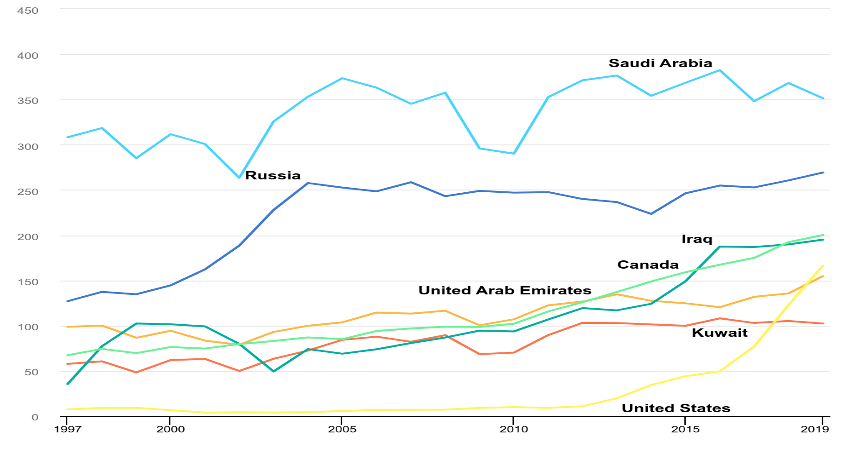
Source: International Energy Agency.
In 2003, crude oil exports from the GCC to the US were rather substantial—2 MBD (1.5 MBD from Saudi Arabia plus 0.5 MBD from Kuwait), accounting for 20.5% of total US crude oil imports. [[4]] A retaliation against Saudi Arabia would have raised the prices of oil and other commodities and damaged the economies of oil importing countries.
Delusion in Washington
In August 2002, the U.S. Central Command’s war plan for invading Iraq postulated that the US would have only 5,000 troops left in Iraq as of December 2006. [[5]] The reality, however, was different: There were 141,000 US military personnel on the ground in Iraq at the end of December 2006, [[6]] plus 30,000 joined the battlefield in the “surge” of January 2007. [[7]] Complete troop withdrawal had to wait four more years till December 18, 2011.
Two months before the start of the war, answering a question on how much money the Department of Defence would need to pay for a war, Secretary of Defence Donald Rumsfeld, said: Well, the Office of Management and Budget has come up with a number that’s something under $50 billion for the cost. How much of that would be the US burden and how much would be other countries is an open question. [[8]] However, the Iraq cost $3 trillion, according to a 2008 estimate by Joseph Stiglitz and Linda Bilmes. [[9]] Harvard University’s Kennedy School estimated in 2013 that the wars in Iraq and Afghanistan cost the US between $4 trillion and $6 trillion. [[10]] President Trump said in a tweet in 2017, that the United States had foolishly spent $7 trillion in the Middle East. [[11]]
The human cost between March 2003 and the departure of the last soldier in December 2011, was heavy too: 4,484 soldiers killed (out of 4,802 coalition casualties) and many times this number wounded. [[12]]
As for the moral cost, the images of torture, humiliation, and death inflicted by American soldiers, men and women, upon Iraqi prisoners at the notorious Abu Ghraib Prison were nauseating. They damaged America’s goodwill around the world.
On March 20, 2003, the US won the battle against a tattered Iraq, but Iran without firing a shot, won control over Iraq, a triumph for the Khomeini revolution and Shi’ism for the first time since the advent of Islam.
Disaster in Iraq
No one knows the exact number of the dead and wounded the American occupation inflicted on a rather small country of 25 million people (in 2003). Two million could be an understatement. Major Iraqi cities and towns were pulverized.
Most damaging was the sectarian civil war the occupation unleashed. It turned Iraqi society on its head. In Baghdad, a city of seven million inhabitants, it was rather common for Shi’ite and Sunni families to intermarry. The war made members of the same family enemies of one another.
The United Nations University International Leadership Institute said on April 27, 2005, that some 84 percent of Iraq’s higher education institutions were burnt, looted or destroyed. [[13]]
Oxfam and Iraqi NGOs reported on July 30, 2007, that of Iraq’s population, 70 percent was without adequate clean water, 80 percent had no access to effective sanitation, 15 percent regularly could not afford to eat, 92 percent of children suffered from learning problems, and nearly 30 percent of children were malnourished. [[14]]
A UNICEF report released on June 27, 2017, said: Over 3 million children don’t attend school on a regular basis, while 1.2 million children are out of school. More than 5 million children are in need of urgent humanitarian assistance. [[15]]
The Orange Kool-Aid
To sell the war to the American people, Vice President Dick Cheney said that Iraqis would receive America’s troops with open arms. In a speech to the Veterans of Foreign Wars national convention in Nashville, Tennessee on August 27, 2002, Cheney said: As for the reaction of the Arab ‘street,’ the Middle East expert Professor Fouad Ajami predicts that after liberation, the streets in Basra and Baghdad are sure to erupt in joy in the same way the throngs in Kabul greeted the Americans. [[16]]
The Administration concocted and propagated that Iraq had:
1) A connection to al-Qaeda.
2) Attempted to obtain uranium from the Central African country of Niger.
3) Attempted to acquire more than 100,000 high-strength aluminum tubes for gas centrifuges for use in enriching uranium.
4) Possessed stocks of chemical and biological weapons and continued the development of weapons of mass destruction.
Iraq vehemently denied these fabrications. The first three were discredited before the start of the war. The fourth had to wait until Iraq was occupied. It, too, proved to be false. The US Senate’s 145-page Report of the Select Committee on Intelligence (RSCI) on Post War Findings about Iraq’s WMD Programs and Links to Terrorism and How They Compare with Prewar Assessments with Additional Views (RSCI) dated September 8, 2006, discredited all accusations in the clearest of terms. [[17]]
1) Connection to Al-Qaeda
Without proof, the Bush administration’s message against Iraq, “honed for public consumption by Rupert Murdoch’s Fox News and the Weekly Standard, seemed to be that the hunt for al-Qaeda could not eradicate terrorism, because bin Laden and his Taliban hosts were mere puppets. The man pulling the strings was in fact Saddam Hussein.” [[18]] The majority of Americans believed this message. In February 2003, a few weeks before the March attack, a CNN-Time poll found that 76 percent of those surveyed believed Saddam aided al-Qaeda. [[19]] In a speech on October 7, 2001, in Cincinnati, Ohio, the President said:
We know that Iraq and al Qaeda have had high-level contacts that go back a decade. Some al Qaeda leaders who fled Afghanistan went to Iraq. These include one very senior al Qaeda leader who received medical treatment in Baghdad this year, and who has been associated with planning for chemical and biological attacks. We’ve learned that Iraq has trained al-Qaeda members in bomb making and poisons and deadly gases. Iraq could decide on any given day to provide a biological or chemical weapon to a terrorist group or individual terrorists. Alliance with terrorists could allow the Iraqi regime to attack America without leaving any fingerprints. [[20]]
Saddam’s regime could be accused of a million crimes, but not of promoting Islamist extremism or aiding jihadism. Under Saddam’s regime, Iraq was the bulwark against Islamist fanaticism. We don’t see any evidence of al-Qaeda in Iraq. Not as a base, not as financial support, a senior Israeli official said on October 27, 2001, reported the New York Times. [[21]]
However, in an interview with NBC’s Meet the Press on December 9, 2001, Vice President Dick Cheney said, “It’s been pretty well confirmed that Atta [the leader of the September 11 attacks] did go to Prague, and he did meet with a senior official of the Iraqi intelligence service in (the Czech Republic) last April, several months before the attack. [[22]]
The New York Times reported on October 21, 2002, that the Czech president, Vaclav Havel, quietly told the White House he had concluded that there was no evidence to confirm earlier reports that Muhammad Atta, had met with an Iraqi intelligence officer in Prague just months before the attacks on New York and Washington. [[23]]
The RSCI report concluded on this issue that, Saddam Hussein was distrustful of al-Qaeda and viewed Islamic extremists as a threat to his regime, refusing all requests from al-Qaeda to provide material or operational support. [[24]] On the Iraqi regime’s support of Abu Mus’ab al-Zarqawi (merged with al-Qaeda in 2004), RSCI said, Saddam Hussein attempted, unsuccessfully, to locate and capture al-Zarqawi, and that the regime did not have a relationship with, harbor, or turn a blind eye toward Zarqawi. [[25]]
It is notable that the president of the United States repeated in a speech as late as mid-August 2006 that, Saddam Hussein … had relations with Zarqawi. [[26]]
2) Attempt to Obtain Uranium from the Central African Country of Niger
President Bush, in his January 28, 2003, State of the Union address, declared that: The British government has learned that Saddam Hussein recently sought significant quantities of uranium from Africa. [[27]]
Well before the president’s speech, in February 2002, the CIA had dispatched US Ambassador Joseph Wilson to Niger to investigate. Joseph Wilson was a career foreign service officer and ambassador who in the mid-1970s had been a diplomat in Niamey, Niger’s capital. Wilson advised the CIA and the State Department that the Niger story was bogus. Ambassador Wilson’s findings were ignored. Ambassador Wilson published his findings on July 6, 2003. inthe New York Times article entitled, What I Didn’t Find in Africa. [[28]]
3) Attempts to Acquire High-Strength Aluminum Tubes for Gas Centrifuges
In the weeks leading up to the war, Dick Cheney and National Security Advisor Condoleezza Rice repeatedly claimed that Iraq had attempted to acquire more than 100,000 high-strength aluminum tubes for gas centrifuges to be used for enriching uranium. President Bush declared at the UN General Assembly on September 12, 2002, that Iraq has made several attempts to buy high-strength aluminum tubes used to enrich uranium for a nuclear weapon. [[29]] He later repeated the accusation on several occasions, including the State of the Union Address on January 28, 2003: Our intelligence sources tell us that he [Saddam Hussein] has attempted to purchase high-strength aluminum tubes suitable for nuclear weapons production. [[30]] The aluminum tubes story was also part of General Powell’s case to the UN on February 5, 2003, when he asserted that Saddam Hussein made repeated covert attempts to acquire high-specification aluminum tubes from eleven different countries. [[31]]
The CIA emphasized that the tubes were intended specifically for centrifuges. Experts at the Department of Energy’s (DOE) Oak Ridge, Livermore, and Los Alamos National Laboratories disagreed because the tube dimensions were far from ideal for this purpose. The DOE pointed out that if these tubes were for centrifuges, there should be evidence of Iraqi attempts to acquire hundreds of thousands of other very specific components, but no such evidence existed. This critique of the CIA interpretation was seconded by the State Department Intelligence Branch, and also by the international group of centrifuge experts advising the International Atomic Energy Agency (IAEA). Mr. Powell had even been briefed by the IAEA about its disagreement with the CIA analysis. [[32]]
4) Possessing Stocks of Chemical and Biological Weapons and Continued Development of Weapons of Mass Destruction
In his, State of the Union Address on January 28, 2003, President Bush described Saddam Hussein’s stockpile of hundreds of tons of deadly chemical and biological weapons as follows:
Saddam Hussein had the materials to produce as much as 500 tons of sarin, mustard, and VX nerve agent. In such quantities, the President continued, these chemical agents could also kill untold thousands, and added that, Iraq, in the late 1990s, had several mobile biological weapons labs designed to produce germ warfare agents, which can be moved from place to a place to evade inspectors. As for delivery munitions, the president disclosed, US intelligence indicates that Saddam Hussein had upwards of 30,000 munitions capable of delivering chemical agents. [[33]]
Powell presented a video of a modified fuel tank for an F-1 Mirage jet obtained by UNSCOM some years before, noting that the spray coming from beneath the Mirage was 2,000 liters of simulated anthrax. [[34]] As if to strengthen his argument, Mr. Powell referred glowingly to a UK government report entitled: Iraq, Its Infrastructure of Concealment, Deception, and Intimidation, published one week earlier, on January 30, 2003, saying:
I would call my colleagues’ attention to the fine paper that the UK distributed … which describes in exquisite detail Iraqi deception activities. [[35]]
The Downing Street authors claimed that they drew upon a number of sources, including intelligence material. In fact, they copied material from at least three different authors and gave no credit to them. Indeed, they plagiarized, directly cutting and pasting. [[36]] One of the sources was an essay by a graduate student at a US university, complete with spelling errors, published in the Middle East Review of International Affairs (MERIA), a professional journal published in Israel. Channel 4 UK TV reported:
The student’s work regarding the Iraqi intelligence structure was written in a historical perspective on pre-1991 Iraq and was used in the document as a description of today’s Iraq. Apart from pages 6 to 16 that have been directly cut and pasted, other sections have had words altered to make it sound more sinister. Even typographic mistakes in the original article were repeated.” [[37]]
Hans Blix, the UN chief weapons inspector, disputed Mr. Powell’s evidence at the Security Council on February 5, 2003. Dr. Blix stated there was no evidence of mobile biological weapons laboratories or of Iraq trying to evade inspectors by moving equipment before his teams arrived. Dr. Blix said he had already inspected two alleged mobile labs and found nothing. [[38]]
On March 7, 2003, the Director-General of the IAEA, Mohammad al-Baradei, presented to the UN the IAEA’s findings regarding Iraq’s nuclear activities during the previous decade. He said:
After three months of intrusive inspections, the Agency had found no evidence or plausible indication of the revival of a nuclear weapons program in Iraq. There was also no indication that Iraq had attempted to import uranium since 1990 or that it had attempted to import aluminum tubes for use in centrifuge enrichment. [[39]]
But Cheney contradicted the IAEA’s chief on NBC Television on March 16, 2005:
We believe Saddam Hussein has, in fact, reconstituted nuclear weapons. I think Mr. al-Baradei frankly is wrong. If you look at the track record of the International Atomic Energy Agency and this kind of issue, especially where Iraq is concerned, they consistently underestimated or missed what Saddam Hussein was doing. [[40]]
On the possession and continued development of nuclear and chemical weapons of mass destruction (WMD) and the means to deliver them, this accusation proved to be false as well. The 1,000-page Comprehensive Report of the Special Advisor to the Director of Central Intelligence Agency on Iraq’s Weapons of Mass Destruction (named the Duelfer Report), released on April 25, 2006, found no such weapons, despite the keen interest of the war managers and the vast expense and diligence of 1,200 inspectors for one-and-a-half years. [[41]] On January 12, 2005, the search for WMD in Iraq stopped and the inspectors returned home. [[42]] On April 26, 2005, the United States closed the book on the Iraq WMD hunt. [[43]]
Colin Powell came to regret his performance. In an ABC television interview in September 2005, he described his presentation as “painful” and a permanent “blot” on his record. I’m the one who presented it on behalf of the United States to the world, adding: It was painful. It’s painful now. [[44]]
How Might these Failures Be Explained?
The intelligence might have been obtained from dubious sources without verification, tailored to fit the narrative of the White House, or invented. Senator Angus King said during the confirmation hearing of Mike Pompeo on January 12, 2017, to lead the Central Intelligence Agency:
The great foreign policy mistakes of my lifetime – Vietnam, the Bay of Pigs, and Iraq – all were based in one way or another on bad intelligence or, more accurately, intelligence that was tailored to fit the demands of the policymakers. You can’t read the histories of those decisions without coming to that conclusion. [[45]]
The Plan to Invade Iraq Before 9/11
On January 26, 1998, almost four years before September 11, 2001, regime change in Iraq had been on the minds of certain Washington politicians. Eighteen individuals, many of whom became senior officials in the first administration of President George W. Bush, sent an open letter to President Bill Clinton urging him to remove Saddam Hussein from power. [[46]] Part of the letter stated:
We urge you to seize [the] opportunity and to enunciate a new strategy that would secure the interests of the USA and our friends and allies around the world. That strategy should aim, above all, at the removal of Saddam Hussein’s regime from power. [[47]]
On October 31, 1998, the Congress passed, and President Bill Clinton signed the Iraq Liberation Act. It declares that, among others, it should be the policy of the United States to:
Seek to remove the Saddam Hussein regime from power in Iraq and to replace it with a democratic government…. Designate one or more Iraqi democratic opposition organizations that meet specified criteria as eligible to receive assistance under this Act. [[48]]
The occupation of Iraq was consistent with the recommendations contained in a report written in September 2000 by the neo-conservative think-tank, Project for the New American Century (PNAC), entitled Rebuilding America’s Defenses: Strategies, Forces and Resources for a New Century. [[49]]
The story of Iraq’s weapons of mass destruction was a late invention. In 2001, the Bush administration spoke confidently of how effective the American policy of containment had been. Secretary of State Powell stated in Cairo on February 24, 2001, that:
Saddam Hussein has not developed any significant capability with respect to weapons of mass destruction. He is unable to project conventional power against his neighbours. [[50]]
Ostensible Undeclared Motives
Why was the Bush administration in a hurry to invade Iraq? Aside from the declared falsehoods, there were five hidden reasons behind the invasion and occupation of Iraq.
1) Control of Iraq’s Vast Crude Oil Reserves and Exports
Iraq has one of the world’s largest proven crude oil reserves, estimated at 112 billion barrels (in 2002). [[51]] Adding Iraq’s crude oil reserves and exports to those already under American control in Saudi Arabia, Kuwait, Qatar, and the UAE would have effectively completed America’s control over Arab oil resources, estimated at more than half of the world’s proven oil reserves and around 50% of global crude oil exports. In a world addicted to crude oil, US control over oil exports is like a non-lethal weapon of mass destruction that can be used against major oil importing rivals, like China.
US intentions toward Iraq’s oil may be seen from documents secured by the public interest group Judicial Watch in July 2003:
Vice President Dick Cheney has been plotting the conquest of Iraq since he was Secretary of Defense in President George H.W. Bush’s administration—a plan then considered insane aggression. On July 17, 2003, Judicial Watch announced that Cheney’s Energy Task Force had developed a map of Iraq dated March 2001, as well as maps of the neighboring United Arab Emirates (U.A.E.) and Saudi Arabia, which show that Cheney knew precisely how much the conquest of Iraq would be worth. The map, which shows oilfields, pipelines, tanker terminals, and refineries, includes eight “blocks” for exploration near the border with Saudi Arabia. [[52]]
Significantly, on April 9, 2003, the day Baghdad fell, US troops proceeded to protect the oil ministry, while mobs nearby were not prevented from looting and ransacking other ministries, libraries, and museums. Foreign Policy Magazine reporter wrote:
Shortly after the Marines rolled into Baghdad and tore down a statue of Saddam Hussein, I visited the Ministry of Oil. American troops surrounded the sand-colored building, protecting it like a strategic jewel. But not far away, looters were relieving the National Museum of its actual jewels. Baghdad had become a carnival of looting. [[53]]
It is noteworthy that President Trump told the CIA on January 21, 2017, that the US should have stolen Iraq’s oil. [[54]]
2) Hand US Corporations Billions of Dollars in Reconstruction Contracts
To rebuild a destroyed Iraq, hundreds of billions of Dollars would flow to American companies to rebuild and expand oil and gas production and refining facilities, water and sewage treatment plants, electricity and telecommunication networks, highways and byways, harbours, airports, hospitals, school, among others. Indeed, the trillions of dollars spent on the war effort in the region benefited the American military-industrial complex primarily.
3) Use Iraq as a Springboard to Change the Regimes of Iran and Syria
Iraq, Iran, and Syria were three of G. W. Bush’s six members of the axis of evil (in addition to N. Korea, Libya, and Cuba). [[55]]
Regarding Syria’s regime, US policy intentions to weaken Damascus were made clear in a 1996 study titled, A Clean Break: A New Strategy for Securing the Realm. [[56]]
A Clean Breakwas authored by a group of eight pro-Israel American officials and academics, called the Study Group on a New Israeli Strategy Toward 2000. It was Led by former US Assistant Secretary of Defense, Richard Perle. [[57]] The Study advocated the removal of Saddam Hussein from power to weaken Syria. It advised Prime Minister-elect Benjamin Netanyahuto:
Work closely with Turkey and Jordan to contain, destabilize, and roll back’ regional threats, help overthrow [Saddam] Hussein and strike Syrian military targets in Lebanon and possibly in Syria proper. [[58]]
With Iraq and Syria potentially under US control, a Pax-Americana involving Arabs and Israelis may have tantalized a born-again Christian like G. W. Bush to pursue (see below: Appease US evangelical Christians). In a speech to the Veterans of Foreign Wars national convention in Nashville, Tennessee on August 27, 2002, Cheney declared that in occupying Iraq, the Administrations’ ability to advance the Israeli-Palestinian peace process would be enhanced. [[59]]
Regarding the ayatollahs, changing the Tehran regime could have turned a hostile anti-US theocracy into a secular democratic pro-American country. It could have completed US control over Middle East oil exports by adding Iran’s oil wealth and opened a market of 70 million (in 2003) Iranians to US companies.
4) Spread Democracy in the Arab World
In 2005 and 2006, the Bush administration embarked on a program to steer Arab countries to hold democratic elections. The results were not encouraging.
– Palestinian Authority (PA): Hamas participated in the elections for the first time. In a high voter turnout of 77.7 percent, it won 74 of the 132 seats in parliament, or 56 percent. [[60]] This was despite the Bush administration’s fervent effort, including the use of aid money to enhance the popularity of the Palestinian Authority. [[61]]
– Iraq: In the elections for the Transitional National Assembly on January 30, 2005, Grand Ayatollah Ali al-Sistani’s list of candidates won 140 of the 275 seats. [[62]] In the December 15, 2005, elections, the Sistani list won 128 out of 275 seats. [[63]]
– Saudi Arabia: When Riyadh finally agreed in early 2005 to conduct for the first time a form of elections, it was municipal elections. Women were barred from running for office or voting. Only men over the age of 21 were allowed to vote. The government appointed one-half of the 1,184 seats in the 178 councils. When the councils were finally announced in December 2005, ten months after the first round was held, the municipal affairs minister declared that the councils would have largely advisory roles on local affairs. Candidates backed by conservative Muslim scholars won most of the seats. [[64]]
– Egypt: On September 7, 2005, President Husni Mubarak was re-elected by a majority of 88.6 percent of the votes cast. Turnout was low—23 percent of Egypt’s 32 million registered voters. [[65]] Opposition groups alleged voter intimidation, people casting more than one vote, and busing voters to polling stations to vote for Mr. Mubarak. [[66]] The difference between Mubarak’s performance in 2005 and his four previous farcical referendums was minimal; 88.6 percent as compared with 98.5 percent in 1981; 97.1 percent in 1987; 96.3 percent in 1993; and 93.8 percent in 1999.
Also, in Egypt’s parliamentary elections in November-December 2005, members of the banned Muslim Brotherhood stood as independents. They won 88 seats, almost 20% of the total. They became the biggest opposition bloc in Egypt’s modern history. [[67]] They could have won more seats had they been recognized as a legal party and allowed to campaign freely.
With such experience, the Bush administration’s faith in Arab democracy was disappointing.
5) Appease US Evangelical Christians
Election votes give America’s Evangelical Christians, and their more extreme cousins, Christian Zionists, a significant influence over US politics in the Middle East. Professor Paul S. Boyer: [[68]]
Millions of Americans – upwards of 40 percent, do, indeed, believe that Bible prophecies detail a specific sequence of end-times events. Leaders have always invoked God’s blessing on their wars and, in this respect, the Bush administration is simply carrying on a familiar tradition. But when our born-again president describes the nation’s foreign-policy objective in theological terms as a global struggle against “evildoers,” and when, in his recent State of the Union address, he casts Saddam Hussein as a demonic, quasi-supernatural figure who could unleash “a day of horror like none we have ever known,” he is not only playing upon our still-raw memories of 9/11. He is also invoking a powerful and ancient apocalyptic vocabulary that for millions of prophecy believers conveys a specific and thrilling message of an approaching end – not just of Saddam, but of human history as we know it.
The Political Earthquake G. W. Bush Unleashed in the Middle East
G. W. Bush empowered Iran, wittingly or unwittingly. He eliminated for Tehran two arch enemies, to the East; the Taliban regime of Afghanistan in 2001 for harbouring Usama bin Laden’s al-Qaeda terrorists, to the West; Saddam Hussein in 2003 on false pretences.
The interaction between Saddam Hussein and the White House goes back to the time Jimmy Carter was President (January 20, 1977 – January 20, 1981) and Ayatollah Rohullah Khomeini returned to Tehran from exile on February 1, 1979.
Saddam’s regime was the bulwark against Khomeini’s declared strategy to export Shi’ite fever and wilayet al-fakeeh style of governance (rulership / guardianship by the senior-most Shi’ite cleric jurist) to Iran’s Sunni Arab neighbours. Pre-emptively, Saddam attacked Iran on September 22, 1980, in a war that raged for eight gruelling years. The US provided Saddam with logistical support. The GCC helped with funding.
Iraq came out of the war in financial ruins. It owed $37 billion to its Gulf creditors. [[69]] Saddam called on Kuwait to cancel its loans, arguing that Iraq lost its sons to protect Kuwait and the rest of GCC regimes from Iranian expansionism. Kuwait refused. On August 2, 1990, Saddam’s army occupied Kuwait. On February 28, 1991, a coalition of 34 nations, led by President George H. W. Bush, liberated Kuwait. Saddam was not replaced. This task was left to his son, G. W. Bush.
On March 20, 2003, G. W. attacked Iraq. On May 1, 2003, Baghdad fell. On December 13, 2003, Saddam was arrested. His trial started on October 19, 2005. He was sentenced to death on November 5, 2006. He was executed on December 30, 2006.
When president Obama withdrew from Iraq on December 18, 2011, Ayatollah Ali Khamenei, the Supreme Leader who succeeded Khomeini after his death in 1980, controlled the Baghdad government. His instrument was a sectarian pro-Iran Shi’ite activist prime Minister, Nouri al-Maliki (2006 – 2014). Maliki had lived in exile in Iran for eight years (1982 – 1990) and in Iran’s proxy, the Asad regime in Damascus, for thirteen years (1990 – 2003).
G. W. Bush won the battle against a tattered Iraq, but Iran without firing a shot, won the battle for Iraq, a historical moment for Shi’ism since the dawn of Islam, a regional political earthquake.
Southern Iraq as Shi’ism’s Holy Land
Persians and Arabs fought wars over the long sweep of history. Islam deepened the divide between Persians and Arabs. Fundamental differences between Shi’i and Sunni Islam make it possible to describe Shi’i Islam as Arab Islam Persianized.
Southern Iraq is home to seven of Shi’ism’s twelve holy shrines. These are the burial places of the Imams, descendants from Imam Ali bin Abi Talib, the Prophet’s cousin, son in law, and the fourth Caliph. [[70]] Four of the remaining five Imams are buried in the Baqi Cemetery in Medina, Saudi Arabia and one is in Mashhad, Iran.
The seven shrines are celebrations of grand architecture, golden domes, and tall golden minarets. The city of Najaf, 175-kilometers South of Baghdad, is home to the spectacular mausoleum of Ali bin Abi Talib. Midway between Najaf and Baghdad is Karbala, home to the magnificent mausoleum of Ali’s son, Imam Hussein. Millions of pilgrims from Iran and other parts of the world visit the Imams’ shrines every year. Top on the religious calendar is the solemn Day of Ashura, the commemorative day in 680 when Imam Hussein was killed in Karbala by forces of the Omayyad Caliph in Damascus, Yazid, on the 10th of Muharram, the first month of the Islamic lunar calendar. [[71]] Kazimayn, a suburb of Baghdad, is home to the splendid final resting palaces of the seventh and the ninth Imams. In Samarra, 125-kilometer North of Baghdad, the tenth and eleventh Imams are buried in impressive opulent mosques. Samarra is also home to the venerable Mosque of the Occultation of the Hidden Imam.
Over the ages, some pilgrims did not return home. They remained near the holy shrines to live, meditate, and die, fusing through marriage, trade, and cultural bonds Arab and Persian into an inseparable mix.
The Najaf Hawza (seminary), established in the Eleventh Century, is the world’s greatest Shi’ite center for learning. Every important Shi’ite religious personality must have spent time studying there. Since 1970, two Grand Ayatollahs from Iran led the Najaf Hawza—Abu Gharib Al-Qassim Al-Khoei (1970 – 1992) and Ali Al-Sistani (1992-present). Sistani was born near Mashhad, Iran. He moved to Najaf in 1952 for further education. [[72]] The leader of the Iranian Revolution, Khomeini, lived in exile in Najaf for thirteen years, from September 5, 1965, until the Iraqi government asked him to leave on October 3, 1978. [[73]] In the Najaf Hawza, at the Sheikh Murtada Ansari Madrasa (school or college), Khomeini taught fiqh (Islamic jurisprudence) and refined his thought on the concept of wilayat al-faqih.
The Marginalization of Arab Shi’ites
Iran and Southern Iraq share almost 600 kilometres of land border. Of world’s Shi’ites, Iran accounts for around 50 percent, Iraq accounts for around 15 percent, and GCC states are home to around 2.5 percent, living along the oil producing areas of the Eastern shore of the Arabian Peninsula.
Shi’ites are drawn together by memories of centuries of suffering at the hands of their Sunni co-religionists. Saudi Arabia’s oil rich Eastern Province is home to the country’s Shi’ite population. While Saudi Shi’ites are a minority of around 15 percent among Saudi nationals, they are most of the population of the Eastern Province. The al-Saud rulers treat their Shi’ite subjects as second-class citizens. In Kuwait, the Shi’ites are a minority of around one third of Kuwaiti nationals. They suffer discrimination under the ruling al-Sabah clan. In Bahrain, Shi’ites are the majority among national Bahrainis. They are discriminated against by the House of al-Khalifa. The UAE claims three small strategic islands, Abu Musa; Greater Tunb; and Lesser Tunb, occupied by the Shah of Iran in 1971. There are large minorities of Shi’ites in Yemen and Lebanon.
Arab Shi’ites consider Iran as their defender. They look to the leading ayatollah in Qom for deliverance. Egyptian President Husni Mubarak said in 2006 that Shi’tes in Iraq and across the Middle East are more loyal to Iran than to their own countries. [[74]]
Arrogance and Ignorance in the White House
What might have caused the failure of the G. W. Bush project in Iraq? The answer is ignorance and arrogance of the war planners. Most of those “experts” never visited Iraq or Iran before the occupation, or studied Arabic, Persian, the Quran, Sunnism, Shiism. They were a product of hostile Hollywood movies and Madison Avenue propaganda depicting Arabs and Muslims as nefarious. Ignorance was behind the mistaken belief that Iraqis in their millions would welcome the invaders with roses, or that the Arab masses would want to copy the Bush democratic model in Iraq. Arrogance was behind the feeling of self-righteousness and that God, and the gun are on the America’s side.
Questions about G. W. Bush’s understanding of the Middle East was raised in a book by former U.S. ambassador Peter Galbraith, The End of Iraq: How American Incompetence Created A War Without End. According to Galbraith, the president didn’t understand as recently as 2002 that there were two major branches of Islam in Iraq — Sunnis and Shi’ites. At a meeting with Iraqi Americans the president reportedly said, I thought the Iraqis were Muslims. [[75]]
While shock and awe bombing runs were pummelling Iraq, weaponizing the Qur’an was also in high gear transforming jihadists into walking bombs:
Belief in predestination + Quranic commands to fight invaders + Promise of paradise for the martyrs = suicide bombers.
To pretend that the failures during the occupation years from 2003 to 2011 were tactical in an otherwise sound strategy is a brazen spin. To blame the failures on Iraq’s ethnic and sectarian divisions or the meddling of neighbours is cowardly. Was it not the White House’s ill-conceived strategy that opened the gates of hell of ethnic and sectarian divisions in Iraq and invited the meddling of neighbours?
As for those former officials of the G. W. Bush administration who were relentless in their eagerness for the war and who later found it convenient to blame the failures on the Bush administration’s mismanagement, such finger pointing is morally bankrupt. Richard Perle and Kenneth Adelman attacked the Bush team in Vanity Fair Magazine. Both had been senior defense department officials and members of a Pentagon advisory board. Both had argued vociferously for the war in Iraq. Richard Perle declared that had he known how it would turn out, he would have been against it. I think now I probably would have said, ‘No, let’s consider other strategies. Kenneth Adelman said, They turned out to be among the most incompetent teams in the post-war era . . . Not only did each of them, individually, have enormous flaws, but together they were deadly, dysfunctional. Donald Rumsfeld fooled me, Adelman added. [[76]]
In a speech in October 2007 the former commander of coalition forces in Iraq, retired general Ricardo Sanchez labelled his political leaders as incompetent and corrupted and declared that they would have faced courts martial for dereliction of duty had they been in the military. [[77]]
In their book, A World Transformed, President George H. W. Bush and Brent Scowcroft wrote on why the first Bush decided against occupying Iraq in 1991: “Had we gone the invasion route, the United States could conceivably still be an occupying power in a bitterly hostile land. It would have been a dramatically different—and perhaps barren—outcome.”
In March 1991, when he was defense secretary, Dick Cheney toed the Bush line. He said on ABC-TV, in answer to a question as to why US forces did not go to Baghdad to remove Saddam Hussein from power:
“I think for us to get American military personnel involved in a civil war inside Iraq would literally be a quagmire. Once we got to Baghdad, what would we do? Who would we put in power? What kind of government? Would it be a Sunni government, a Shi’ite government, a Kurdish government? Would it be secular, along the lines of the Baath party? Would it be fundamentalist Islamic. I do not think the United States wants to have US military forces accept casualties and accept responsibility of trying to govern Iraq. It makes no sense at all.”
Footnotes
[1]. 846 million tons x 7.33 bbl./ton = 6,201 million bbl. /365 days = 17 million bbl./day (MBD).
“World top crude and NGL exporters, 1997-2019”, International Energy Agency,
https://www.iea.org/data-and-statistics/charts/world-top-crude-and-ngl-exporters-1997-2019
[2]. 325 million tons / 846 million tons = 38.53% x 17 MBD = 6.55 MBD.
[3]. 49 million tons / 846 million tons = 5.79% x 17 MBD = 0.98 MBD.
[4]. Ehsan Soltani, “U.S. Shift Away from Saudi and GCC Crude Oil Imports”, Voronoi, (May 15, 2025),
https://www.voronoiapp.com/energy/-US-Shift-Away-from-Saudi-and-GCC-Crude-Oil-Imports-5101
[5]. The National Security Archive, National Security Archive Electronic Briefing Book No. 214, (February 14, 2007), http://nsarchive.gwu.edu/NSAEBB/NSAEBB214/index.htm
[6]. Peter Spiegel, “Troop levels in Iraq may rise”, Los Angeles Times, (November 16, 2006),
https://www.latimes.com/archives/la-xpm-2006-nov-16-na-usiraq16-story.htm
[7]. Gary Sheftick, “Army marks 10th anniversary of troop surge in Iraq”, US Army, (April 27, 2017),
https://www.army.mil/article/186745/army_marks_10th_anniversary_of_troop_surge_in_iraq
[8]. Interview Transcript, “Rumsfeld Briefs Press,” CNN, (January 19, 2003),
https://transcripts.cnn.com/show/se/date/2003-01-19/segment/01
[9]. Joseph Stiglitz and Linda Bilmes, The Three Trillion Dollar War, The True Cost of the Iraqi Conflict, (Allen Lane, an imprint of Penguin Books, 2008.
[10]. Linda J. Bilmes, The Financial Legacy of Iraq and Afghanistan: How Wartime Spending Decisions Will Constrain Future National Security Budgets,”Harvard University: Faculty Research Working Paper Series, (March 2013),
[11]. Alana Horowitz Satlin, “Trump Bemoans War Costs as Pence Promises Afghanistan To ‘See this Through’”, Huffingpost, (December 22, 2017),
https://www.huffingtonpost.co.uk/entry/trump-war-costs-afghanistan_us_5a3d0667e4b06d1621b3df68
[12]. Simon Rogers, “War in Iraq: the cost in American lives and dollars,” The Guardian, (December 15, 2011),
https://www.theguardian.com/news/datablog/2011/dec/15/war-iraq-costs-us-lives
[13]. “The Current Status and Future Prospects for the Transformation and Reconstruction of the Higher Education System in Iraq”, pdf download, United nations university Iraq higher education.
[14]. “Rising to the Humanitarian Challenge in Iraq”,
http://news.bbc.co.uk/1/shared/bsp/hi/pdfs/18_07_07_oxfam_iraq.pdf
[15]. “Nowhere to Go: Children in Iraq Trapped in Cycles of Violence and Poverty,” UNICEF, (June 27, 2017).
https://www.unicef.org/media/media_96529.html
[16]. “Full text of Dick Cheney’s Speech,” The Guardian, (August 27, 2002).
https://www.theguardian.com/world/2002/aug/27/usa.iraq
[17]. Select Committee on Intelligence, “Post War Findings About Iraq’s WMD Programs and Links to Terrorism and How They Compare with Prewar Assessments with Additional Views,” United States Senate, (September 8, 2006),
https://fas.org/irp/congress/2006_rpt/srpt109-331.pdf
[18]. Giles Kepel, The War for Muslim Minds. Islam and the West, Belknap/Harvard, 2004, P. 197.
[19]. Bruce Morton, “Selling an Iraq–Al-Qaeda Connection,” CNN, (March 11, 2003).
http://www.twf.org/News/Y2003/0312-IraqalQaeda.html
[20]. President George W. Bush, “Remarks by the President on Iraq: President Bush Outlines Iraqi Threat,” Official White House Transcript, (October 7, 2002),
https://georgewbush-whitehouse.archives.gov/news/releases/2002/10/print/20021007-8.html
[21]. Patrick Tyler and John Tagliabue, “A Nation Challenged: The Investigation; Czechs Confirm Iraqi Agent Met with Terror Ringleader,” The New York Times, (October 27, 2001),
[22]. Vice President Dick Cheney, “The Vice President Appears on NBC’s Meet the Press,” Official White House Transcript, (December 9, 2001),
[23]. James Risen, “Threats and Responses: The View from Prague; Prague Discounts an Iraqi Meeting,” The New York Times, (October 21, 2002),
[24]. Select Committee on Intelligence, “Post War Findings About Iraq’s WMD Programs and Links to Terrorism and How They Compare with Prewar Assessments with Additional Views,” P. 105.
[25]. Ibid. P. 109.
[26]. “Saddam ‘Had No Link to al-Qaeda,’” BBC, (September 9, 2006),
http://news.bbc.co.uk/1/hi/5328592.stm
[27]. Full Transcript, “Bush’s State of the Union Speech,” CNN, (January 29, 2003),
http://edition.cnn.com/2003/ALLPOLITICS/01/28/sotu.transcript/
[28]. Joseph C. Wilson, “What I Didn’t Find in Africa,” The New York Times, (July 6, 2003),
http://www.nytimes.com/2003/07/06/opinion/what-i-didn-t-find-in-africa.html
[29]. Full Transcript, “President Bush’s Address to the United Nations,” CNN, (September 12, 2002),
http://edition.cnn.com/2002/US/09/12/bush.transcript/
[30]. “Bush’s State of the Union Speech,” CNN.
[31]. “Powell’s Key Points on Iraq,” CNN, (February 5, 2003),
http://edition.cnn.com/2003/US/02/05/sprj.irq.key.points.txt/index.html
[32]. Scientific Integrity in Policy Making, The Bush Administration’s Misuse of Science. Misrepresenting Evidence on Iraq’s Aluminum Tubes,
http://webexhibits.org/bush/9.html
[33]. Full Transcript, “Bush’s State of the Union Speech,” CNN, (January 29, 2003),
http://edition.cnn.com/2003/ALLPOLITICS/01/28/sotu.transcript/
[34]. “Transcript of Powell’s UN Presentation,” CNN, (February 5, 2003).
http://edition.cnn.com/2003/US/02/05/sprj.irq.powell.transcript.05/
[35]. Ibid.
[36]. “Full text of Colin Powell’s Speech,” The Guardian, (February 5, 2003),
https://www.theguardian.com/world/2003/feb/05/iraq.usa
[37]. Glen Rangwala, “British Intelligence Iraq Dossier Relies on Recycled Academic Articles,” Center for Research on Globalisation, (February 5, 2003),
http://globalresearch.ca/articles/RAN302A.html
[38]. Channel 4 UK TV, “Part of Colin Powell’s Address to the UN Was Plagiarized: It Was Copied and Pasted from a Website!” (February 6, 2003),
http://globalresearch.ca/articles/CHF302A.html
[39]. Dan Plesch, “US Claim Dismissed by Blix,” The Guardian, (February 5, 2003), http://www.guardian.co.uk/international/story/0,3604,889133,00.html
[40]. United Nations, “United Nations Weapons Inspectors Report to Security Council on Progress in Disarmament of Iraq,” (March 7, 2003),
http://www.un.org/press/en/2003/sc7682.doc.htm
[41]. “Transcript for Meet the Press with Dick Cheney,” NBC News, (Sept 14, 2003),
http://www.nbcnews.com/id/3080244/#.WHF9Qnecb6k
[42]. US Government Publishing Office, Comprehensive Report of the Special Advisor to the DCI on Iraq’s WMD, with Addendums (Duelfer Report), (April 25, 2005)
https://www.gpo.gov/fdsys/pkg/GPO-DUELFERREPORT/content-detail.html
[43]. “US gives up search for Iraq WMD,” BBC, (January 12, 2005),
http://news.bbc.co.uk/2/hi/americas/4169107.stm
[44]. “US Closes Book on Iraq WMD Hunt,” BBC, (April 26, 2005),
http://news.bbc.co.uk/2/hi/americas/4484237.stm
[45]. Steven Weisman, “Powell Calls His UN Speech a Lasting Blot on His Record,”The New York Times, (September 9, 2005),
[46]. Full Transcript, “Confirmation Hearing of Mike Pompeo for CIA Director,” CNN, (January 12, 2017),
http://transcripts.cnn.com/TRANSCRIPTS/1701/12/ath.02.html
[47]. The authors of the letter included Richard Perle (head of the Pentagon’s defense policy board), Richard Armitage (deputy secretary of state), John Bolton (under-secretary of state), Paula Dobriansky (under-secretary of state), Elliott Abrams (presidential advisor for the Middle East and a member of the US National Security Council), Peter W. Rodman (assistant secretary of defense for international security affairs), Zalmay Khalilzad (special envoy to the Iraqi opposition), Robert B. Zoellick (US trade representative), Paul Wolfowitz (deputy secretary of defense), and former CIA director James Woolsey.
[48]. Project for the New American Century, Letter to President Clinton, January 26, 1998,
https://noi.org/wp-content/uploads/2016/01/iraqclintonletter1998-01-26-Copy.pdf
[49]. US Congress, “Iraq Liberation Act of 1998,” Congress.gov,
https://www.congress.gov/bill/105th-congress/house-bill/4655
[50]. The Project for the New American Century, Rebuilding America’s Defenses, Strategy, Forces and Resources for a New Century, (September 2000),
https://resistir.info/livros/rebuilding_americas_defenses.pdf
[51]. “Powell ’01: WMD Not ‘Significant’,” CBS NEWS, (September 28, 2003),
https://www.cbsnews.com/news/powell-01-wmds-not-significant
[52]. Gal Luft, “How Much Oil Does Iraq Have?,” Brookings, (May 12, 2003),
https://www.brookings.edu/research/how-much-oil-does-iraq-have
[53]. Scott Thompson, “Dick Cheney Has Long Planned to Loot Iraqi Oil,” by Scott Thompson, Executive Intelligence Review, (August 1, 2003),
http://www.larouchepub.com/other/2003/3030cheney_oil.html
[54]. Peter Maas, “The Ministry of Oil Defense”, Foreign Policy, (August 5, 2010), https://foreignpolicy.com/2010/08/05/the-ministry-of-oil-defense/
[55]. Matt Fuller, “President Trump Just Told The CIA The US Should Have Stolen Iraq’s Oil,” The Huffington Post, (January 21, 2017),
http://www.huffingtonpost.com/entry/trump-cia-iraq-oil_us_5883ccf5e4b096b4a23243b2
[56]. Frank Gardner, “Who’s Who in the ‘Axis of Evil,’” BBC, (December 20, 2003),
http://news.bbc.co.uk/1/hi/1988810.stm
[57]. The Institute for Advanced Strategic and Political Studies, Study Group on a New Israeli Strategy Toward 2000, A Clean Break: A New Strategy for Securing the Realm,
https://www.sourcewatch.org/index.php/Study_Group_on_a_New_Israeli_Strategy_Toward_2000
[58]. Richard Perle (head of the defense policy board), Douglas Feith, (undersecretary of defense for policy), James Colbert (Jewish Institute for National Security Affairs, Israel), Charles Fairbanks, Jr. (Johns Hopkins University/SAIS), Robert Loewenberg (President, Institute for Advanced Strategic and Political Studies), Jonathan Torop (The Washington Institute for Near East Policy), David Wurmser (Institute for Advanced Strategic and Political Studies), Meyrav Wurmser (Johns Hopkins University),
[59]. “Study Group on a New Israeli Strategy Toward 2000”, Sourcewatch.org.,
https://www.sourcewatch.org/index.php/Study_Group_on_a_New_Israeli_Strategy_Toward_2000
[60]. “Full text of Dick Cheney’s Speech,” The Guardian, (August 27, 2002),
https://www.theguardian.com/world/2002/aug/27/usa.iraq
[61]. GolobalSecurity.Org, “Palestinian Parliamentary Elections 2006”,
http://www.globalsecurity.org/military/world/palestine/pa-elections2006.htm
[61]. Scott Wilson and Glenn Kessler, “US Funds Enter Fray in Palestinian Elections,” Washington Post, (January 22, 2006),
http://www.washingtonpost.com/wp-dyn/content/article/2006/01/21/AR2006012101431.html
[62]. “Iraqi Shia Unite to Contest Poll,” BBC, (October 27, 2005), http://news.bbc.co.uk/1/hi/world/middle_east/4382640.stm
[63]. “Guide to Iraqi Political Parties,” BBC, (January 20, 2006),
http://news.bbc.co.uk/1/hi/world/middle_east/4511450.stm
[64]. “Saudi Councils Finally Announced,” BBC, (December 15, 2005),
http://news.bbc.co.uk/1/hi/world/middle_east/4531862.stm
[65]. “Landslide Win for Egyptian Leader,” BBC, (September 9, 2005),
http://news.bbc.co.uk/2/hi/middle_east/4231338.stm
[66]. “Egypt Challenger to Seek Re-run,” BBC, (September 8, 2005),
http://news.bbc.co.uk/2/hi/middle_east/4225912.stm
[67]. Yolande Knell, “Egypt’s Muslim Brotherhood campaigns through clampdown”, BBC, (November 27, 2010),
https://www.bbc.co.uk/news/world-middle-east-11832643
[68]. Paul S. Boyer, “When U.S. Foreign Policy Meets Biblical Prophecy,” AlterNet, (February 20, 2003),
[69]. “The Gulf War”, Office of the Historian, Department of State, United States of America, (1991),
https://history.state.gov/milestones/1989-1992/gulf-war
[70]. The twelve Imams are: Ali Bin Abi Talib (600-661), Hasan Bin Ali (625-670), Husain Bi Ali (626-680), Ali Zain al-Abideen (658-712), Muhammad al-Baqir (677-732), Ja’far al-Sadek (702-765), Musa al-Kazem (744-799), Ali al-Rida (765-817), Muhammad al-Jawwad al-Taqi (810-835), Ali al-Hadi (827-868), Hasan al-Askari (846-874), Muhammad al-Muntazar (868- ).
[71]. Syed Shahriyar, “Photos: Arbaeen, one of the world’s largest annual pilgrimages in Iraq”, Aljazeera, (September 7, 2023),
https://www.aljazeera.com/gallery/2023/9/7/photos-arbaeen-worlds-largest-annual-pilgrimage-in-iraq
[72]. Dilip Hiro, “Iran’s Influence in Iraq,” BBC, April 15, 2004,
http://news.bbc.co.uk/2/hi/middle_east/3629765.stm
[73]. Iran Chamber Society, History of Iran, “Historic Personalities: Ayatullah Khumayni,” http://www.iranchamber.com/history/rkhomeini/ayatollah_khomeini.php
[74]. “Mubarak’s Shia remarks stir anger”, AlJazeera, (April 10, 2006),
https://www.aljazeera.com/news/2006/4/10/mubaraks-shia-remarks-stir-anger
[75]. “Book: Bush Didn’t Know Difference Between Shiites and Sunnis”, Democracy Now, (August 7, 2006),
[76]. Paul Reynolds, “End of the neo-con dream”, BBC, (December 21, 2006),
http://news.bbc.co.uk/1/hi/world/middle_east/6189793.stm
[77]. “US general damns Iraq ‘nightmare’”, BBC, (October 13, 2007),